AI Proposal Generator vs. Proposal Software for Small Teams
Compare AI proposal generators with traditional proposal software. Learn which workflow helps small sales teams quote faster, follow up smarter, and close with less drag.
You finish a good sales call. The buyer has a real problem, the budget seems plausible, and they ask you to send a quote.
Then momentum leaks.
You dig through an old proposal. You copy a scope from a similar client. You update the pricing table, check the dates, rewrite the intro, export a PDF, attach it to an email, and hope you did not leave another client's name in paragraph three.
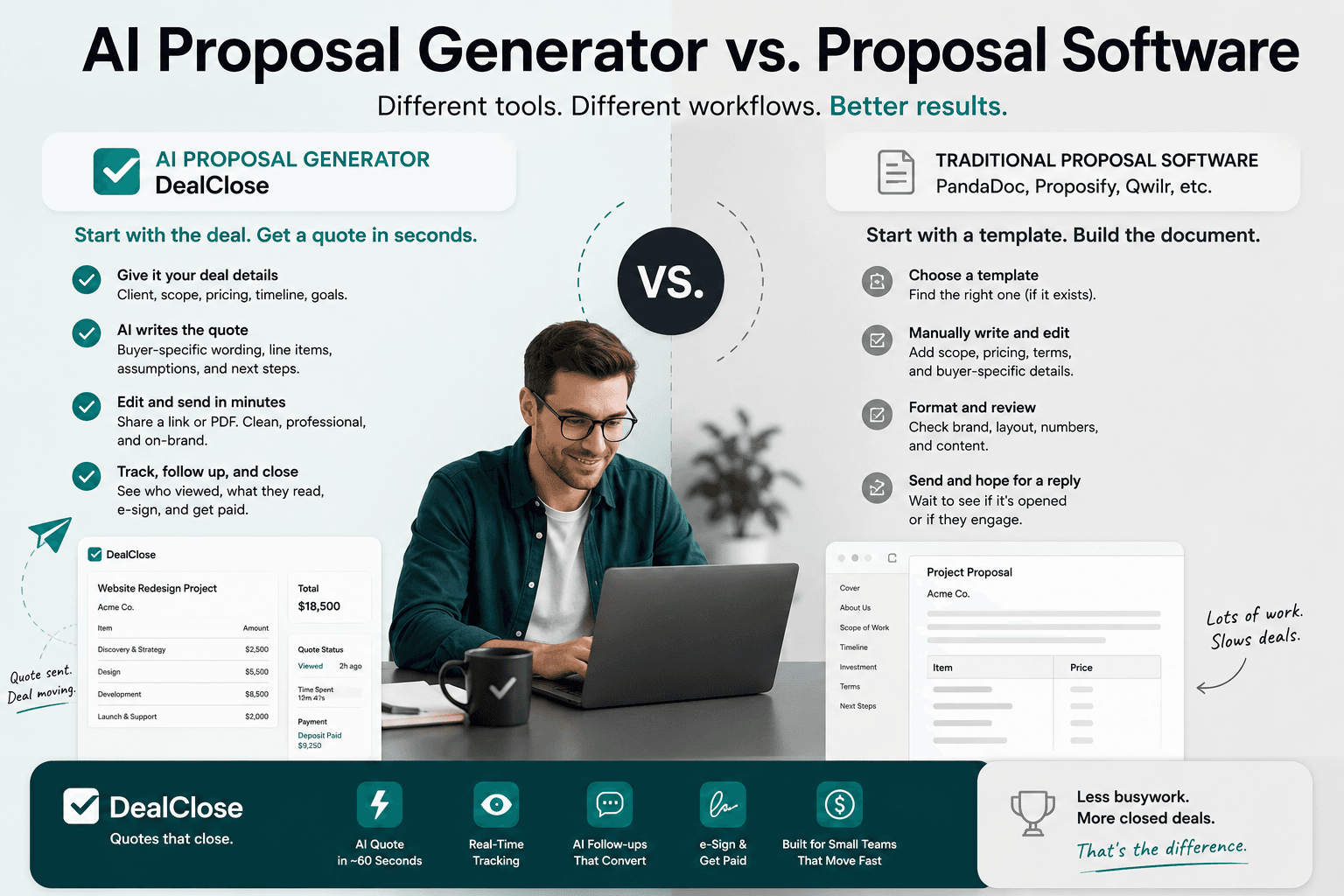
That is the real comparison behind "AI proposal generator vs. proposal software." It is about which workflow gets the right quote in front of the buyer while the deal is still warm.
For freelancers, consultants, agencies, SaaS sellers, IT/MSPs, and small sales teams, the answer depends on what is slowing you down.
The Real Job: Create the Quote, Not Just the Document
Traditional proposal software became popular because proposals were painful to build in Word, Google Docs, spreadsheets, and email. Tools like PandaDoc, Proposify, Qwilr, Better Proposals, and similar platforms made the document workflow easier with templates, drag-and-drop sections, content libraries, e-signatures, analytics, and shared links.
That is valuable. If your team sends long proposals with repeatable sections, brand-heavy layouts, pricing tables, approval rules, and legal language, a document-first platform can bring order to the process.
But many small teams have a different bottleneck. They need a clear quote that says:
- What the buyer asked for
- What problem the work solves
- What is included and excluded
- What it costs
- What happens next
- How the buyer can approve, sign, or pay
That is where an AI proposal generator can be more useful than a traditional template builder.
What Traditional Proposal Software Does Well
Traditional proposal software is strongest when the proposal is a controlled sales document.
- Reusable templates for different services, packages, or industries
- Brand-controlled proposal layouts
- Content libraries for case studies, bios, legal language, and service descriptions
- E-signatures and approval workflows
- Proposal analytics and buyer notifications
- Integrations with CRM, payment, or project management tools
- Internal permissions for teams with multiple reps
This works well for teams that sell repeatable offers at a steady volume. An agency might have templates for paid media, website redesigns, and retainers. A consulting firm might maintain approved language for discovery, implementation, and advisory packages.
The tradeoff is setup. Templates and content blocks need maintenance. Reps need to know which sections to use. Someone has to keep pricing, scope, terms, and brand assets current.
What an AI Proposal Generator Does Differently
An AI proposal generator starts closer to the sales conversation. Instead of opening a template and filling in blanks, you provide the details the buyer gave you: company context, pain points, desired outcome, deliverables, timeline, pricing notes, and next steps.
For sales use, the best AI proposal generator should create a quote that is ready to send, not a generic paragraph that still needs an hour of cleanup.
- Client needs a five-page website refresh
- Main issue is poor lead quality from the current site
- Include copy updates, design, build, launch support
- Timeline is four weeks
- Price is $4,800 with 50% deposit
A quote-first AI workflow should turn that into a professional quote with scope, pricing, assumptions, and next action. From there, the seller can edit, share a link, export a PDF, track views, follow up, collect a signature, and request a deposit.
That is the workflow DealClose.co is built around: AI quote generation, then sending, tracking, follow-up, e-signature, and payment collection instead of stopping at a draft.
Comparison: AI Proposal Generator vs. Traditional Proposal Software
| Decision Point | AI Proposal Generator | Traditional Proposal Software |
|---|---|---|
| Best starting point | Call notes, project details, buyer context | Template, document library, saved content blocks |
| Main strength | Fast buyer-specific first draft | Consistent branded proposal production |
| Best for | Small teams that quote quickly after sales calls | Teams with repeatable proposal processes and governance |
| Setup effort | Lower if the tool is quote-first | Higher if templates, approvals, and libraries need configuration |
| Personalization | Strong when inputs are specific | Strong when reps edit templates carefully |
| Design control | Usually lighter | Usually stronger |
| Tracking | Best when linked to quote views and follow-up | Often strong for proposal views and analytics |
| Closing workflow | Strong if it includes e-signatures and payment | Strong if integrated with contract, CRM, and payment workflows |
| Risk | Generic output if the seller gives weak inputs | Slow, stale, or overbuilt proposals if templates are not maintained |
The key question is, "Which workflow matches how your team sells?"
When an AI-First Quote Workflow Is Better
Choose an AI-first quote workflow when speed and relevance are your biggest problems.
This is common for small teams selling services, implementation work, retainers, software packages, audits, or technical projects. The buyer needs proof you understood the conversation and a simple way to say yes.
- You often send quotes within hours of a call
- Each quote needs buyer-specific language
- Your scope changes from deal to deal
- You sell in a small team without proposal operations support
- You want to know when buyers open or revisit the quote
- You need follow-up help based on buyer engagement
- You want signature and payment in the same flow
For freelancers, the value is speed: turn a messy project brief into a polished quote while the client still remembers the conversation. For consultants, the value is clarity. For agencies, the value is consistency.
When Traditional Proposal Software Is Better
Choose traditional proposal software when document control matters more than speed.
This can be the right call if your proposals are long, visual, or legally complex. It also makes sense when many reps need approved sections, managers review discounts, or the proposal is part of a wider document process.
- You rely on a large template library
- Brand design is a major sales asset
- Your team needs strict approval workflows
- Proposals include case studies, bios, legal sections, or complex appendices
- Multiple departments review documents before sending
- CRM and document governance matter more than speed
- Your proposals are reused more than they are rewritten
The Middle Ground: AI Inside Proposal Software
The market is moving toward overlap. Some proposal platforms now include AI writing assistance, and some AI tools now include tracking, signatures, and payment collection. Buyers should look past labels.
- Can it create a quote from sales notes?
- Can you edit the scope and pricing before sending?
- Can you share a live quote link?
- Can you export a clean PDF?
- Can you track opens and buyer engagement?
- Can it help write the follow-up?
- Can the buyer sign?
- Can the buyer pay a deposit or full amount?
- Can your team control branding and permissions?
- Can you learn which quotes are winning?
This is where sales quote software matters. A proposal is only one part of the deal. The workflow also has to support buyer engagement, approval, signature, and payment.
A Practical Example: Same Sales Call, Two Workflows
Imagine a small MSP finishes a call with a company that needs endpoint management, backup, and onboarding support.
With traditional proposal software, the rep might duplicate the MSP template, remove irrelevant sections, update the company name, add pricing, check service descriptions, and send it for approval. It can take time if the opportunity does not match the template cleanly.
With an AI-first quote workflow, the rep can summarize the call notes, add the service package, include assumptions, and generate a buyer-specific quote. Then they can send a shareable link, watch for buyer activity with quote tracking, and use AI follow-up writing if the buyer views the quote twice but does not respond.
How to Evaluate Tools Without Getting Distracted
Most comparison pages list features. That is useful, but it can hide the real question: what happens when a buyer asks for pricing?
- Time to first draft: Can a seller create a usable buyer-specific quote in minutes?
- Quote accuracy: Does the workflow make pricing, scope, assumptions, and exclusions easy to review?
- Buyer experience: Can the buyer open, review, approve, sign, and pay without friction?
- Seller visibility: Does the team know when the quote is opened, revisited, or ignored?
- Follow-up quality: Can the seller follow up based on buyer intent instead of guessing?
- Team control: Can the business manage branding, users, and quote consistency?
- Learning loop: Can the team see which quotes are viewed, signed, paid, and won?
DealClose.co is designed for teams that want those steps in one quote-first flow: AI generation, shareable links, PDF export, tracking, AI follow-up, e-signatures, payment collection, branding, team controls, and win-rate insights.
When to Choose Each Option
Choose an AI proposal generator if:
- Your quote needs to go out right after the call
- The offer changes from buyer to buyer
- You do not have time to maintain a large template library
- You want AI to turn notes into a strong first draft
- You care about tracking and follow-up as much as document design
- You want signature and payment to happen without extra tools
Choose traditional proposal software if:
- Your proposal is a formal sales asset with heavy design requirements
- Your team sells from approved, repeatable templates
- Multiple stakeholders need to review documents before sending
- You need broad document workflows beyond sales quotes
- Your buyers expect a detailed proposal package with many supporting sections
For many small teams, the best starting point is the workflow that gets a clear, accurate, buyer-specific quote out the door fastest.
What to Do Next
Look at the last five quotes your team sent. For each one, ask:
- How long did it take to create?
- How much was copied from an old proposal?
- Did the buyer get a clear next step?
- Did you know when they viewed it?
- Did follow-up happen at the right time?
- Could they sign or pay without another thread?
If the biggest pain was layout, brand control, or approval routing, traditional proposal software may be the right path.
If the biggest pain was turning sales conversations into accurate quotes quickly, start with an AI-first quote workflow. DealClose.co helps small teams create buyer-specific quotes in about 60 seconds, send trackable links, export PDFs, follow up with context, collect signatures, and move from quote to payment.
FAQ
What is the difference between an AI proposal generator and proposal software?
An AI proposal generator creates proposal or quote content from inputs such as call notes, project details, buyer pain points, scope, and pricing. Traditional proposal software usually starts with templates, document editors, content libraries, and approval workflows. The difference is workflow focus: AI generators help create the first buyer-specific draft faster, while proposal platforms help teams design, manage, and standardize proposal documents.
Is an AI proposal generator good for small business sales?
An AI proposal generator can be a strong fit for small business sales when speed and personalization matter more than complex document production. Freelancers, consultants, agencies, SaaS sellers, and IT/MSPs often need to turn sales call notes into a quote quickly. The best fit is a tool that still lets you review pricing, edit scope, brand the quote, track engagement, capture signatures, and collect payment.
When should I choose traditional proposal software instead?
Choose traditional proposal software when your team relies on a large template library, heavy document design, legal review, approval routing, or multi-team content governance. It can also make sense when proposals are long, highly visual, or reused across many reps. If the main delay is formatting and brand control, a document-first platform may solve more of the problem than an AI-only generator.
Can AI proposal tools replace PandaDoc or Proposify?
AI proposal tools can replace PandaDoc or Proposify for some small teams, but not every team. If you mainly need fast, buyer-specific quotes with tracking, follow-up, signature, and payment collection, an AI-first quote workflow may be simpler. If you need advanced document design, deep template governance, or broad document workflows beyond quotes and proposals, a traditional proposal platform may still be a better fit.
What should small teams look for in quote tracking software?
Small teams should look for quote tracking software that shows when a buyer opens a quote, whether they revisit it, and which actions suggest intent. Tracking is most useful when it connects to follow-up, not just reporting. A strong workflow helps you send the quote, spot buyer engagement, write a relevant follow-up, capture approval, collect an e-signature, and move the deal toward payment.
Create your next quote while the conversation is still fresh.
DealClose.co helps small teams create buyer-specific quotes in about 60 seconds, send trackable links, export PDFs, follow up with context, collect signatures, and move from quote to payment.
Create your next quote